Chief Crazy Horse
aka Chief Greasy Bowl – Between cultures and their mere appropriation

The Master in Paris (AD 1999)
A brief lesson on the path to enlightenment
The path – not just steep and thorny
I always tell my students: the path to enlightenment, well, it’s not just steep and thorny. That would be too simple. No, this path is also lined on both sides by an astonishingly large number of blunders. (NB: In the German language of Goethe, Herder and Kant, there is a term for this: Fettnäpfchen – literally, a small bowl containing greasy fat. In farmhouses, a bowl of fat was kept near the hearth or entrance, often used as boot grease. Anyone who stepped into it carelessly would smear grease across the floor and annoy the housewife – and so the literal misstep became a figurative social faux pas. It is therefore not, as a British dirty-minded person might think, a little pot of Vaseline intended as a lubricant. Yuck, yuck, yuck.)
And we’re not talking about those little, rather decorative pots. No, we’re talking here and now about the larger containers. Specifically, the ones containing stuff that really makes you want to gag. The rule is: the bigger and the nastier the bowl, the more certain you can be that you’ll step right into it with complete conviction.
A blunder has a particularly lovely name:
cultural appropriation
And once you’ve got your foot – or, as this story unfolds, your hoof – in it, then the situation is… let’s call it: unpleasant.
The Year of the Horse
Now it so happens that we are in the year 2026, and the Year of the Horse in the Chinese zodiac is upon us once more. The Chinese zodiac signs, as we know, follow a twelve-year cycle; each year is assigned its own animal – with its own characteristics, interpretations and projections. And as is often the case with such cycles: at some point, you get the feeling they have something to do with you personally.
Pandora’s Box and the first misstep

And somewhere amongst these fragments, I suddenly find myself holding a photograph in my hand. Almost thirty years old. In it: me in front of the Crazy Horse in Paris.
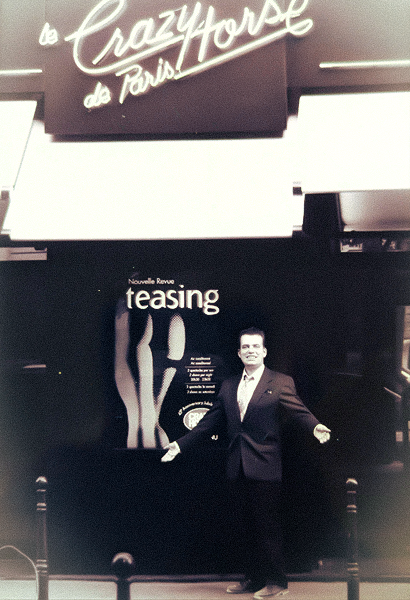
Although – if I’m honest – this idea isn’t new at all. My uncle, Helmut Lauterbach, used to call himself – back in a time when we didn’t really give much thought to such things – well, he gave himself the lovely Native American name:
Chief Lauter Bach
And somehow that stuck with his nephew (me). That sound. That playfulness. That matter-of-factness about simply taking a name for oneself. But let’s be careful. It’s precisely in these moments that it happens. You’re no longer walking. You’re stepping. And right on target, straight into the aforementioned massive blunder.
The thing about names
Because suddenly you realise: you’re not looking for a name. You’re looking for an image. A picture in your head, pieced together from films, stories, half-knowledge. Something to do with ‘chief’. Something to do with ‘horse’. But whilst you’re still piecing it together, it somehow becomes clear: None of this belongs to you.
Let’s Pause
And this is where it’s worth stopping. The cultures from which these images originate are not a projection screen. They have their own terms. Their own structures. Their own meanings. There were no universal ‘chiefs’. There were roles depending on whether it was war or peace. Warriors and peacekeepers. People with responsibilities within a specific system. And there you stand, with your half-baked pun, realising that you’re in the process of simplifying something that isn’t simple at all.
The moment of course correction
The turning point. You can now try to keep galloping along and get it ‘right’. Do a bit more research. Be a bit more precise. Or you can do something else. You let it be. Dismount, let go of the reins for a moment. You crouch down, perhaps light a little pipe to relax.
Whilst idly fiddling about on the ground with your hands, you gather a few of the wild mushrooms and herbs growing there and smoke them straight away. Your gaze wanders into the distance, or follows the pony trotting off in the distance – it doesn’t matter.
Tohuwabohu
And – bang! – somewhere amidst all this, another word suddenly pops up. Tohuwabohu. Not Native American. Not a quote. Not a borrowed meaning. But an old word for what has just happened here: chaos. Disorder. A very personal, very human thought process.
Everything falls into place
And suddenly, the problem becomes a solution. Not by taking something on (or over). But by allowing something to happen.
Let my peace name be:
Kanasó Rono Tohu Wa-Bohu.
Solemnly and respectfully, a bow.
Kanasó·rono (Mohawk, Haudenosaunee) essentially refers to a peacekeeping, organising authority within the context of the ‘Great Law of Peace’ – that is, a role focused on balance, mediation and structural stability within a consensus-based system. Hierarchically, not necessarily at the very top; quite possibly extending down to almost the very bottom, roughly at the level of a ‘group leader’, if you know what I mean...
Tohuwabohu, on the other hand, originates from Hebrew (tohu wa-bohu) and appears in Genesis 1:2; it describes the state of desolate emptiness prior to the divine creation of order and functions, in Christian-influenced interpretation, as a cipher for pre-cosmic chaos.
The Teaching
And perhaps that is precisely the point: the path to insight is not merely steep and thorny. It is lined with moments when we realise that we are currently on the wrong path. And it is precisely there, between putting a foot in it and retreating, that something unique sometimes emerges. If we are only willing not to force things, but simply to take with us whatever we find along the way.
With that in mind: Peace! – or: Skennen! – as the Mohawk say.